Natural Incense Sticks India: Why Charcoal-Free, Himalayan-Made Agarbatti Is Different
Light an ordinary incense stick and within seconds you are inhaling bamboo, charcoal, synthetic binders, and artificial perfume. Light a natural, Himalayan-made incense stick and something entirely different happens — the room fills with the actual botanicals that were rolled into it: pine resin, sandalwood dust, clove bark, wild agarwood. Your lungs know the difference before your mind does.
What Is Actually in Most Commercial Agarbatti?
Walk into any general store in India and the agarbatti shelf will be stacked with brightly packaged sticks promising jasmine, rose, or sandalwood. What those labels rarely mention is what the sticks are actually made of.
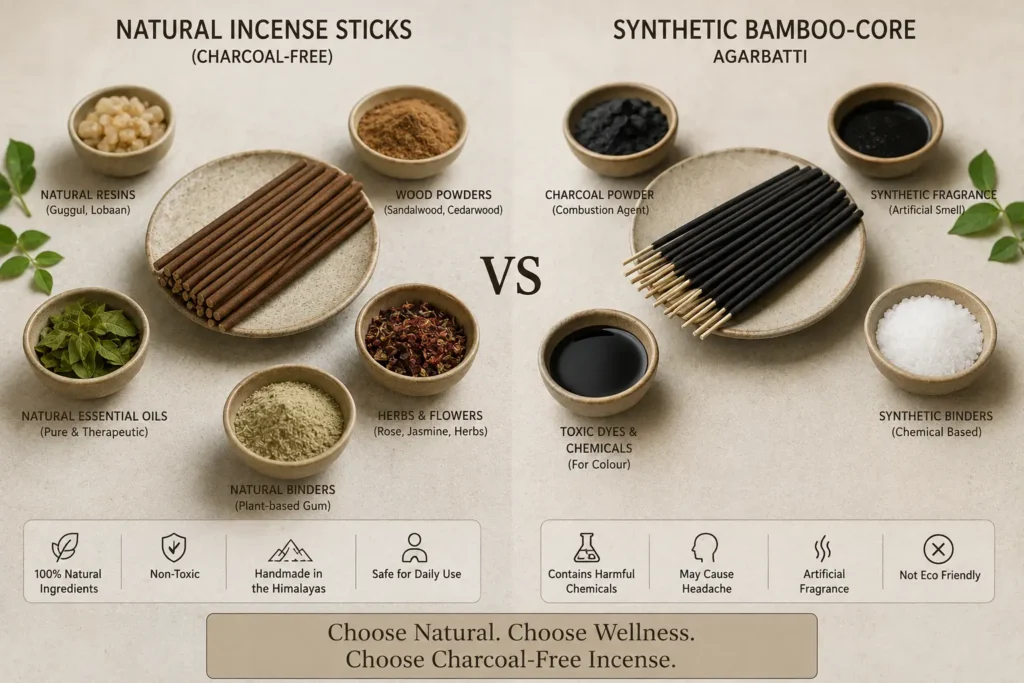
Most mass-market incense sticks in India are produced using a bamboo-core method: a thin bamboo sliver is coated in a paste of charcoal powder, a binding agent (jiggat or makko), synthetic fragrance oil, and sometimes chemical accelerants to ensure an even burn. The result is a product that burns reliably and smells pleasant in a synthetic way — but what you are inhaling is largely charcoal smoke, chemical fragrance compounds, and burning bamboo.
What Makes Natural Incense Sticks Different?
Natural incense sticks — sometimes called masala incense — are made without a bamboo core and without charcoal as a base. Instead, the aromatic ingredients themselves are ground, blended with a natural binding agent (typically makko powder, derived from the Machilus thunbergii tree), and rolled directly into a stick. The stick is the fragrance. Nothing else.
Ingredients in truly natural incense sticks:
- Aromatic resins — agarwood, benzoin, frankincense, myrrh
- Dried wood powders — sandalwood, cedar, pine
- Spices and botanicals — clove, cinnamon, cardamom, herbs
- Dried flowers and roots — rose, vetiver, khus
- Natural binders — makko powder or honey
When you burn a natural masala incense stick, you are burning those botanicals — nothing more. The smoke is cleaner, the ash is finer and whiter, and the scent is truer to the plant it came from rather than a laboratory approximation of it.
The Himalayan Difference: Why Altitude Changes Everything
Plants that grow at high altitude — above 3,000 feet — accumulate higher concentrations of essential oils and aromatic compounds than their lowland counterparts. This is a survival adaptation: the oils protect the plant from UV radiation, temperature swings, and the harsh mountain environment.
For incense, this means that Himalayan-sourced botanicals — pine from the high cedar forests, wild agarwood, rhododendron, mountain herbs — carry a more intense and complex aromatic profile than the same species grown at sea level. The fragrance is not just stronger; it is different in character. More resinous, more layered, with a depth that unfolds slowly as the stick burns.
This is the core reason that traditional Himalayan and Tibetan incense — made from wild-harvested mountain botanicals and hand-rolled without synthetic additions — has been used in monasteries, temples, and Ayurvedic healing practices for centuries. Not for ritual reasons alone, but because the quality of the fragrance is genuinely superior.
What Is Oud (Agarwood) Incense and Why Is It Special?
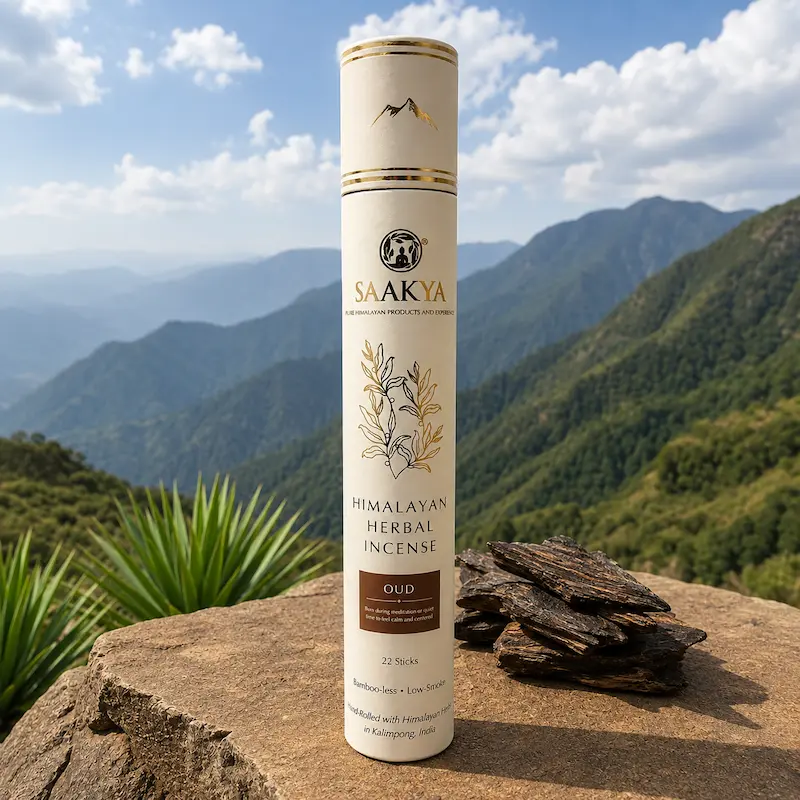
Oud — also known as agarwood, aloeswood, or agaru — is one of the rarest and most prized aromatic ingredients in the world. It comes from the resin-saturated heartwood of the Aquilaria tree, which produces this dark, fragrant resin only when infected by a specific mould. The resulting wood is dense, dark, and extraordinarily aromatic — burned for centuries across the Middle East, South Asia, and East Asia in religious ceremonies, royal courts, and healing practices.
Oud incense is warm, deep, woody, and complex — often described as simultaneously earthy and sweet, with a smoke that seems to change character as it burns. It is grounding and meditative in a way that lighter florals are not. If you have ever walked into a mosque, a high-end perfume house, or a traditional Ayurvedic space that smelled unlike anything ordinary, what you were smelling was almost certainly oud.
Pine, Sandalwood & Clove: Saakya’s Sacred Forest Ritual Pack
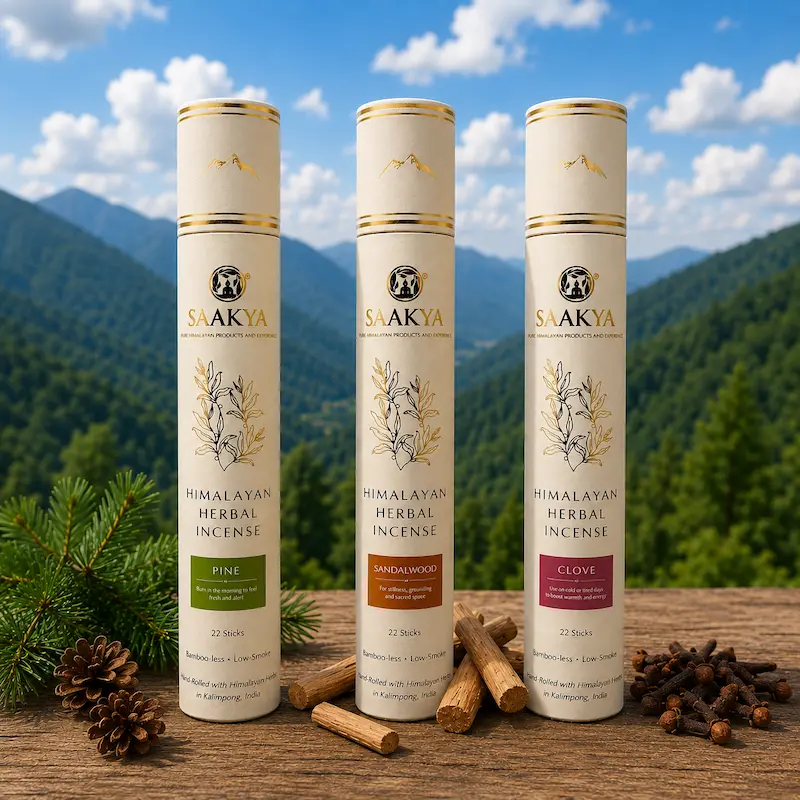
If you are new to natural incense and want to explore more than one fragrance, Saakya’s Sacred Forest Ritual Pack brings together three of the most grounding Himalayan botanicals — pine, sandalwood, and clove — in a single set.
How to Use Natural Incense Sticks for Meditation
Using natural incense sticks correctly deepens the meditation experience rather than distracting from it. Here is a simple guide:

- 1Choose your fragrance with intention: pine or clove to focus and ground; sandalwood or oud to calm and centre; florals to open and uplift.
- 2Place the holder at a comfortable distance — not directly under your nose. You want the fragrance to diffuse through the room, not concentrate in one spot.
- 3Light the tip and let it catch for 5–10 seconds, then gently blow out the flame. The stick should glow and smoulder, not burn with a visible flame.
- 4Ventilate the room slightly — even natural incense produces some particulates. A slightly open window keeps the air fresh without dissipating the fragrance entirely.
- 5Burn time: natural masala incense sticks typically burn for 30–45 minutes — one stick is enough for a full meditation session.
- 6Dispose of ash responsibly — the fine white ash from natural incense can be composted or returned to soil. It contains no synthetic residue.
How to Tell Real Natural Incense from Synthetic: The Burn Test
Not everything labelled “natural” on the market actually is. Here is how to verify what you have at home.
| What to look for | Natural Incense ✅ | Synthetic Incense ❌ |
|---|---|---|
| Ash colour | White or off-white, fine | Grey or black |
| Scent as it burns | Evolves and deepens throughout | Flat, uniform from start to finish |
| Burn behaviour | Slow, even — no flaring | Smell of burning bamboo underneath the fragrance |
| Physical effect | No headache or eye irritation | Eye irritation or headache in a small room |
| Stick appearance | Darker, slightly irregular with visible botanical particles | Perfectly uniform, bright-coloured |
Where to Buy Natural Handmade Incense Sticks Online in India
Natural, charcoal-free incense sticks are still a small category in India’s online market — which means there is a lot of mislabelling and overpromising. When shopping online, look for brands that:
Frequently Asked Questions About Natural Incense Sticks
Natural Incense. Real Botanicals. Nothing Else.
Bamboo-free. Charcoal-free. Handcrafted in the Himalayas. Saakya incense sticks for daily meditation, puja, and mindful living.
The Bottom Line
Most commercial agarbatti is not what it claims to be. The fragrance is synthetic, the base is charcoal, and the core is bamboo — none of which belongs in a mindful, wellness-oriented home practice.
Natural incense sticks — made the masala way, from real botanicals, without charcoal or bamboo — are a fundamentally different product. The fragrance is deeper, the burn is cleaner, and the experience of using them is closer to what incense was always meant to be: a small ritual that brings genuine calm to your space and your breath.
That is what Saakya makes. That is the only kind of incense we will ever make.